Review basis: Research-led; not hands-on. TestedHarbor has not road-tested this camera. We checked Vantrue's current product information and manual, then used attributed independent testing for footage, reliability, and installation observations.
The Vantrue N4 Pro is worth considering for rideshare and other drivers who genuinely need front, cabin, and rear evidence. It is not the best default choice for everyone: a two-channel camera is simpler when interior footage does not solve a real need.
The N4 Pro records 4K front, 1080p infrared cabin, and 1080p rear video simultaneously. Its main buying risks are not hidden in the resolution figure: they are three-camera cable routing, cabin privacy, high storage demand, windshield reflections, and the separate power hardware required for unattended parking mode.
Quick verdict
Buy the N4 Pro for three-channel context, not because 4K alone makes it universally better. It is a strong fit for rideshare, delivery, family vehicles, and drivers who need cabin evidence. Skip it if a front-and-rear system covers your risk with less wiring, lower storage demand, and fewer privacy concerns.
Key specs at a glance
Vantrue's current product information and manual list the N4 Pro as a three-channel camera with 4K front, 1080p infrared cabin, and 1080p rear recording, plus 5 GHz Wi-Fi, GPS, voice control, and support for microSD cards up to 1TB.
Pros
- Three-channel coverage for front, cabin, and rear context.
- 4K front recording, 5GHz Wi-Fi, GPS, and STARVIS 2 are strong headline specs for this class.
- Good fit for rideshare, delivery, family vehicles, and long road trips.
- More useful incident review than a front-only dash cam when passengers, rear traffic, or parking context matter.
Cons
- More installation work than a front-only camera.
- Cabin recording creates privacy questions for some drivers.
- Parking mode may require a hardwire kit or external power accessory.
- Three channels are unnecessary if all you want is basic front-road footage.
What did independent testing find?
Tom's Guide tested the Vantrue N4 Pro for two weeks and reported clear footage in well-lit conditions and reliable operation. The same review also found visible windshield reflections without the optional polarizing filter and said that hiding the multi-camera wiring took substantially longer than mounting the camera itself.
Those observations support the N4 Pro's core strengths and tradeoffs, but they remain one publication's experience in one installation. TestedHarbor has not reproduced its road tests, so we do not assign our own plate-readability, night-video, or reliability score.
Daytime footage
The independent review found strong well-lit video. Moving plates can still become unreadable because of speed, angle, glare, and exposure.
Windshield reflections
Reflections were a documented weakness without the optional circular polarizing filter, so treat that accessory as part of the setup decision.
Installation
Initial mounting was straightforward, but cleanly routing the front, cabin, and rear-camera wiring was the time-consuming part.
Reliability
The camera operated reliably during that two-week review. That is useful evidence, not a long-term durability guarantee.
Vantrue N4 Pro vs N4 Pro S, Viofo A229 Pro, and simpler setups
The main reason to choose the Vantrue N4 Pro is not just resolution. It is coverage. A three-channel camera gives you a wider record of what happened around the vehicle, but that wider record comes with a more involved setup.
| Option | Best for | Main trade-off |
|---|---|---|
| Vantrue N4 Pro | Rideshare, delivery, family vehicles, road trips, and drivers who want front, cabin, and rear context. | More installation work than a front-only camera, and storage/power setup matters. |
| Vantrue N4 Pro S | Drivers who want a 2.5K rear camera, STARVIS 2 sensors across all three channels, and an external IP67 rear camera. | Usually a higher-spec and potentially higher-cost choice; optional LTE is available in the wider N4 Pro ecosystem and is not an S-only reason to upgrade. |
| Viofo A229 Pro | Cross-shoppers who want to compare another enthusiast-favorite dash cam ecosystem before choosing a 3-channel setup. | Do not decide from specs alone. Compare sample footage, app workflow, accessories, warranty, and installation needs. |
| Front-and-rear dash cam | Most daily drivers who want road coverage ahead and behind the vehicle. | No cabin context if an interior event matters. |
| Front-only 4K dash cam | Simple accident footage, easy installation, and lower setup complexity. | Misses rear impacts, cabin events, and some parking context. |
Design and installation
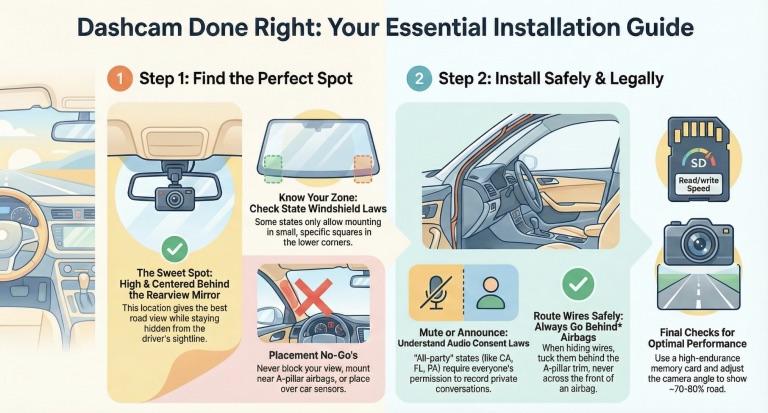
A three-channel dash cam is more demanding to install than a front-only unit. The front camera needs a clean windshield position, the rear camera needs cable routing toward the back window, and the cabin camera should be aimed without blocking the driver's view or becoming a distraction.
The rear-camera cable is the part buyers often underestimate. A clean install may require routing trim, avoiding airbags, leaving slack at the hatch or trunk, and making sure the rear lens is not blocked by tint, defroster lines, cargo, or headrests.
That extra effort is the trade-off. Once installed well, a three-channel setup can record more of the driving environment without requiring the driver to manage multiple separate cameras.
Front, cabin, and rear coverage
The front camera is still the most important part of any dash cam. It records traffic, lane position, signs, intersections, and the moments leading up to an incident. The 4K front camera is the reason the N4 Pro belongs in the same conversation as other premium dash cams, but resolution alone does not guarantee readable plates.
The rear camera adds context for tailgating, rear-end impacts, and parking movement behind the vehicle. The cabin camera is the feature that separates a three-channel setup from a normal front-and-rear kit. It is most useful when interior context matters: passenger disputes, rideshare trips, delivery work, family vehicles, or reviewing what happened inside the car during a sudden stop or incident.
Cabin recording is not automatically right for everyone. If privacy matters, check whether cabin video or audio recording can be disabled before you buy.
Parking mode and night use
Parking mode is one of the main reasons drivers look beyond basic dash cams. If your car is parked on the street, in an apartment lot, at a shopping center, or near busy curbside traffic, unattended recording can be more useful than another daytime driving clip.
The important detail is power. Many parking mode features require a hardwire kit or external battery pack. Before buying, check the current Vantrue bundle and installation requirements so you know whether the camera will record while parked in the way you expect. If the kit is not included, budget for it before you compare the N4 Pro against cheaper cameras.
Night footage also deserves skepticism. STARVIS 2, HDR, and PlatePix are promising specs, but the real question is whether the camera keeps plates and lane context readable under headlights, rain, glare, and motion. When sample clips are available, judge moving vehicles at night first.
Storage, app, and daily usability
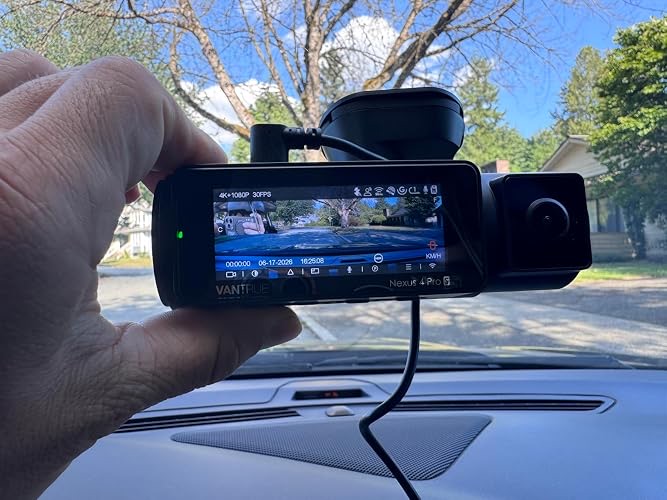
A dash cam only helps if it records reliably and makes important clips easy to find. For any multi-channel camera, use a high-endurance microSD card that is built for repeated recording cycles. Current Vantrue and Amazon listing information says the N4 Pro supports up to a 1TB microSD card; confirm the current card requirements before buying because high-bitrate 3-channel recording fills storage faster than a front-only camera.
5GHz Wi-Fi should make phone transfer more convenient than removing the card for every clip, but the practical questions are simple: can you find the clip, save it, and share it without fighting the app or downloading the wrong file? Those workflow details matter more than many spec-sheet claims.
Who should buy the Vantrue N4 Pro?
- Uber and Lyft drivers: cabin footage can add context for passenger trips, disputes, and sudden stops.
- Delivery drivers: front, cabin, and rear footage can help document frequent stops, curbside loading, and busy urban driving.
- Families: broader coverage can be useful for shared vehicles and road trips.
- Street or apartment parking: parking mode support can matter when unattended damage is a concern.
- Drivers comparing premium dash cams: the N4 Pro belongs on the list if you want 4K front video plus cabin and rear context.
Who should skip it?
Skip the Vantrue N4 Pro if you want the simplest possible install, do not want cabin recording, or only need basic front-road footage. A front-only 4K dash cam or a front-and-rear kit can be easier to install and may be enough for many daily drivers. Also skip it if you want parking protection but are not willing to install a hardwire kit or maintain an external battery pack.
Check current Vantrue N4 Pro bundle options
Vantrue bundles, hardwire kits, memory card requirements, coupons, and pricing can change. Before buying, confirm whether the listing includes the accessories you need for parking mode and 3-channel recording.
Final verdict
The Vantrue N4 Pro is best understood as a coverage upgrade. It is not the simplest dash cam choice, and it is not necessary for every driver. But if you want front, cabin, and rear footage in one setup, it gives you a more complete record than a front-only camera can provide.
For rideshare, delivery, family driving, road trips, and parking situations where cabin context matters, the Vantrue N4 Pro is worth comparing. For drivers who only want easy road recording, a simpler dash cam may be the better buy. Choose the N4 Pro S instead when its 2.5K external rear camera and three STARVIS 2 sensors justify the additional cost.
Sources and evidence
- Vantrue N4 Pro official product page — recording formats, sensor, connectivity, storage, and parking-mode requirements.
- Vantrue N4 Pro user manual — channel files, loop recording, event recording, and parking-power setup.
- Tom's Guide independent review — attributed two-week observations on footage, reflections, wiring, and reliability.
- Vantrue N4 Pro S official product page — rear-camera and sensor differences used in the comparison.
Sources were checked on July 31, 2026. Manufacturer pages support specifications; the independent review supports only the observations attributed to it.
FAQ
Is the Vantrue N4 Pro worth it for daily driving?
The Vantrue N4 Pro is worth considering when you need front, cabin, and rear evidence in one system. Daily drivers who only need road footage may find a front-only or two-channel camera easier to install and manage.
Is the Vantrue N4 Pro good for Uber or Lyft drivers?
Yes. Its infrared cabin camera adds passenger and interior context while the front and rear cameras cover traffic around the vehicle. Drivers should check local audio-consent rules and rideshare-platform policies before recording passengers.
Does Vantrue N4 Pro parking mode require extra wiring?
Yes, unattended parking recording needs compatible constant power. Vantrue says its parking modes require a hardwire kit, which is sold separately, or another supported power solution. Confirm low-voltage protection and installation requirements before buying.
What memory card size does the Vantrue N4 Pro support?
Vantrue lists support for microSD cards up to 1TB. Use a compatible high-endurance card because simultaneous three-channel recording creates frequent write cycles and fills storage faster than a front-only camera.
How is the Vantrue N4 Pro different from the N4 Pro S?
The N4 Pro S raises the rear camera to 2.5K, uses STARVIS 2 sensors across all three channels, and has an external IP67 rear camera. Optional LTE is not exclusive to the S model, so it should not be the deciding difference.
Is cabin recording necessary?
Cabin recording is useful when passenger, driver, or interior context matters. If that evidence is not relevant, a two-channel front-and-rear camera avoids an extra video stream and reduces privacy concerns.