Review basis: Research-led; not a TestedHarbor hands-on test. We checked BLUETTI's current US product pages, manuals, warranty policy, and named independent reporting. Manufacturer figures below are labeled as published specifications rather than TestedHarbor measurements. See our evidence standards.
BLUETTI is worth comparing when you want quiet, rechargeable power for selected devices, not a substitute for an unplanned whole-home electrical system. Elite 30 V2 is the small-device option. Elite 100 V2 is the more portable 1kWh-class starting point. Elite 200 V2 adds materially more stored energy and output for heavier loads, while Elite 300 is for buyers who need roughly 3kWh and can accept a much larger unit.
The common mistake is shopping by battery size alone. Watt-hours determine the rough energy window; watts determine whether the inverter can support the device in the first place. A power-hungry appliance can drain a large battery quickly, and a compressor or tool may have a startup surge that exceeds an otherwise plausible wattage figure. Start with the load plan, then choose the smallest station that actually fits it.
Quick verdict
Choose the Elite 100 V2 for a portable 1kWh-class starting point, move to Elite 200 V2 when longer runtime or higher output solves a defined need, and consider Elite 300 only when its added capacity is more useful than its extra size. Elite 30 V2 makes sense for phones, lights, cameras, and small low-power backup. Do not buy a larger unit merely because it has more outlets or a headline solar number. Skip a portable station as the primary plan when you need automatic whole-home transfer, major HVAC loads, or permanent circuit integration.
Small electronics and short trips
Start with Elite 30 V2 when the job is phones, lights, cameras, and modest laptop use. It is not the right capacity class for an extended appliance plan.
Camping and selected essentials
Elite 100 V2 is the portable 1kWh-class comparison point when you need more than a small power bank but still need to lift and move the station easily.
Longer essential-load window
Elite 200 V2 and Elite 300 trade portability for capacity. Choose only after measuring continuous draw, startup behavior, and the hours that matter.
BLUETTI power stations compared by the job they need to do
The figures below are current manufacturer-published US specifications checked on August 25, 2026. They are useful for screening models, but runtime, solar charge speed, and usable output change with temperature, load profile, cable setup, and the exact configuration. Confirm the live listing before checkout.
| Model | Published capacity and AC output | Best starting use | Buying caution |
|---|---|---|---|
| Elite 30 V2 | 288Wh; 600W | Small electronics, short outings, compact emergency kit | Capacity is intentionally limited; it is not an overnight appliance backup plan |
| Elite 100 V2 | 1,024Wh; 1,800W | Camping, road trips, CPAP or router backup, selected household essentials | High-draw appliances reduce runtime quickly; verify outlet count and exact bundle |
| Elite 200 V2 | 2,073.6Wh; 2,600W | Longer essential-load window, RV use, and buyers with a measured higher-wattage need | Published weight is 53.4 lb; portability has a practical limit |
| Elite 300 | 3,014Wh; 2,400W | Large-capacity RV and selected home-essential backup | More energy does not create a whole-home transfer system or make every appliance compatible |
Which BLUETTI model should you compare?
BLUETTI Elite 30 V2
Official specifications plus independent testElite 30 V2 is the small-capacity branch of the lineup: BLUETTI publishes 288Wh and 600W, which makes it a reasonable comparison point for USB devices, lights, cameras, a laptop, and brief low-power backup. TechRadar's hands-on testing likewise positions it as a compact model for travel, camping, and storm-outage device charging, not a large-battery substitute.
Its limitation is simple and should be treated as a feature of the size class rather than a flaw. A 288Wh battery cannot sustain a high-wattage heating appliance, a long compressor load, or several days of home essentials. Buy it when compactness is the benefit; move up when the measured load plan says you need more energy.
BLUETTI Elite 100 V2
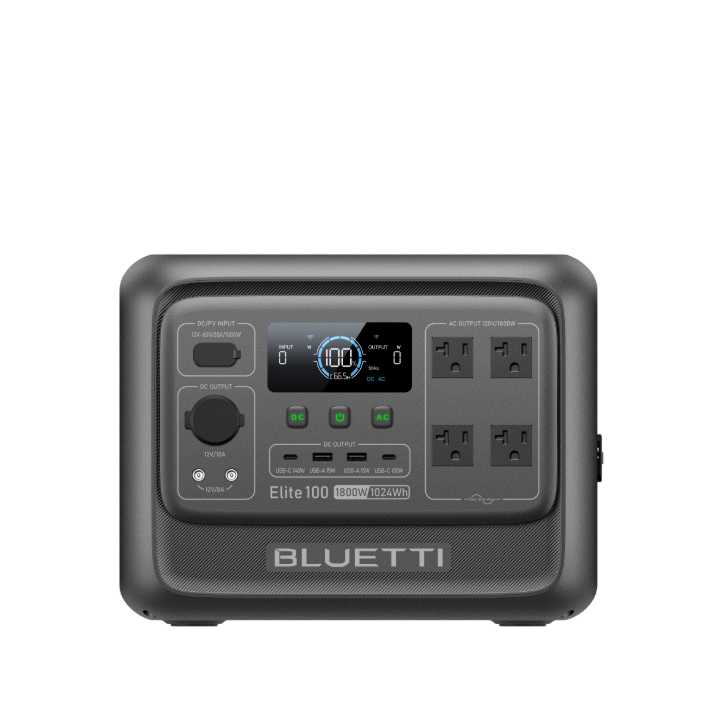
Official specifications plus independent testElite 100 V2 is the practical middle ground for buyers who need meaningfully more than a small charging station but still expect to carry it. BLUETTI publishes 1,024Wh, 1,800W output, and about 25 lb. Its official comparison table lists up to 1,000W solar input; that is an input ceiling, not a promise of that charge rate in every weather or panel setup.
TechRadar's hands-on review found the form factor compact and the 1,800W output unusually capable for its size, while noting that 1,024Wh can be limiting with high-draw loads. That is the right reason to choose it for a portable fridge, communications, laptop work, selected CPAP setups, or campsite appliances only after checking their actual power requirements.
Best fit: a buyer who values a movable 1kWh-class station and has measured a moderate, selected-device load rather than an all-household backup expectation.
BLUETTI Elite 200 V2
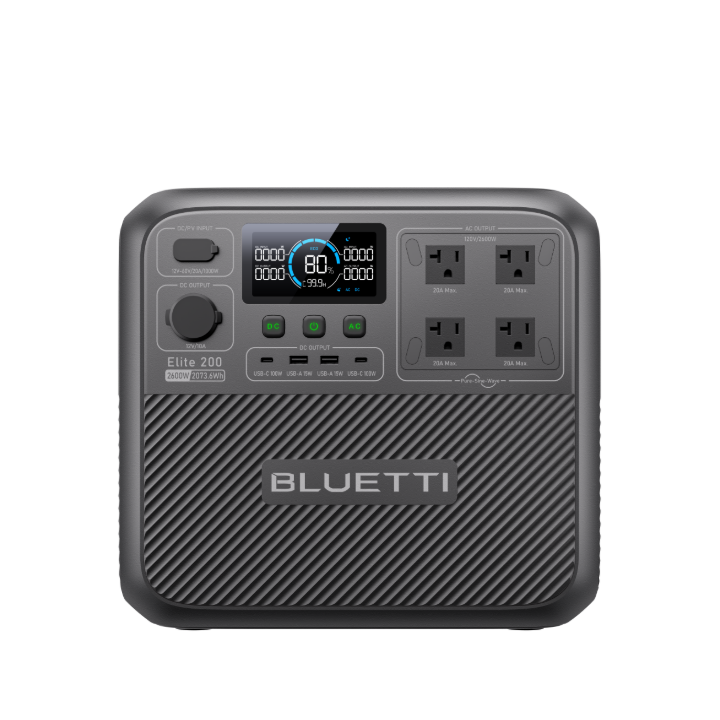
Manufacturer specificationsElite 200 V2 is the capacity step that makes sense when the real problem is a longer essential-load window, higher continuous draw, or an RV setup with a measured load plan. BLUETTI publishes 2,073.6Wh, 2,600W AC output, 1,000W maximum solar input, and a 53.4 lb weight. Those figures explain why it can cover more demanding devices than the 1kWh class, but also why it should not be bought as a casual grab-and-go unit.
Use the weight as a decision variable, not a footnote. Consider where the unit will be stored, whether one person can move it safely, and how far it must travel during an outage. Published appliance-runtime examples assume defined test conditions; a refrigerator's cycling, a pump's startup behavior, and inverter losses mean your outcome will differ.
Best fit: buyers who have measured a larger or higher-wattage essential load and can accommodate a roughly 53 lb power station.
BLUETTI Elite 300
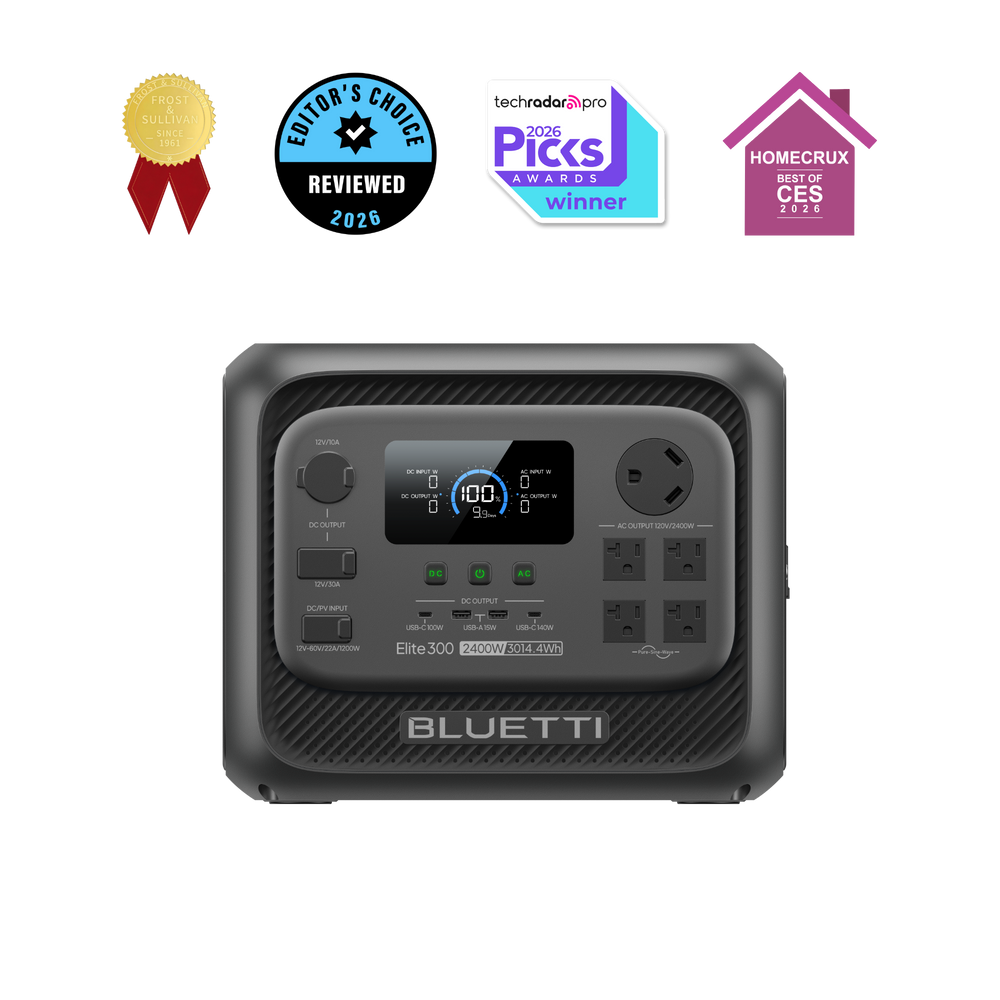
Manufacturer specificationsElite 300 is for buyers whose load plan justifies roughly 3kWh of storage. BLUETTI publishes 3,014Wh and 2,400W output, with a TT-30 outlet and 12V/30A DC port positioned for certain RV uses. It is a more plausible option for a longer selected-device window than the 1kWh class, but it remains an all-in-one power station, not a replacement for correctly designed permanent home backup.
The purchase decision should be about usable scenario coverage, not the largest number in the table. A few low-power essentials can benefit substantially from added capacity. High-heat appliances, central air conditioning, or multiple large loads can still exhaust the battery quickly or exceed the exact product's output and wiring limits.
Best fit: RV users and home-essential planners who need more stored energy and accept the additional space, weight, and budget commitment.
How to estimate runtime without overpromising
Use watt-hours for a conservative planning range, not a guarantee. A simple first estimate is battery capacity multiplied by 0.8, then divided by the appliance's average watts. The 0.8 factor is a planning allowance for conversion and operating losses; it is not a BLUETTI specification or a TestedHarbor measurement. A 1,024Wh battery against a stable 100W load would therefore begin around eight hours on paper, before changes in load, temperature, battery condition, and device cycling.
For an important use case, measure instead of guessing. A plug-in energy meter over a normal day is more useful than an appliance label because refrigerators, CPAP humidifiers, pumps, and charging tools rarely draw their maximum number continuously. Also record startup power for motors and compressors. A station can have enough energy in theory but still reject a load if the inverter cannot handle the peak.
- Capacity: how much energy is stored, expressed in Wh.
- Continuous output: the power the inverter can supply during normal operation, expressed in W.
- Startup surge: a temporary higher demand from some motors and compressors.
- Input limit: the highest power the station can accept from solar, AC, car charging, or a compatible accessory.
Selected-device backup is different from powering home wiring
A portable power station is suitable for selected plug-in devices when its capacity, output, and outlet type fit the load. Do not connect it directly to household wiring or attempt to backfeed a breaker panel. Supplying circuits requires a correctly specified transfer arrangement and a qualified electrician who can account for the exact equipment, load calculation, grounding, local code, and manufacturer instructions.
For outages, make a written priority list: communications, lighting, medical equipment where appropriate, refrigeration, and charging. Treat high-heat appliances, large pumps, and HVAC as separate engineering and electrical decisions. If continuous operation matters, test the actual devices during the return window rather than relying on a marketing runtime chart.
Solar input and bundle checks
Solar panels can extend a trip or outage plan, but a panel's nameplate watts are measured under laboratory conditions. Cloud cover, heat, angle, shade, panel orientation, cable loss, and the power station's own voltage and current limits all affect actual input. Check the exact model's manual before combining panels or using an existing array.
Do not use a bundle photo as proof of compatibility. Confirm the included panel size, connector and adapter, supported input range, cable length, charge controller limit, and whether the listed kit is for the same US model. The same family name can appear in different model years and bundles.
What to check before buying a BLUETTI on Amazon
- Actual devices: list average watts, peak or startup behavior, and the hours needed without recharging.
- Capacity and output: make sure both Wh and continuous W fit the plan; neither substitutes for the other.
- Outlet and voltage configuration: verify the exact US model, AC outlets, USB ports, DC ports, and any RV outlet required.
- Weight and storage: account for lifting, vehicle loading, stairs, ventilation, and accessible charging space.
- Solar setup: confirm the station's supported voltage, current, connector, adapter, and maximum solar input.
- Bundle contents: check whether panels, cables, car chargers, accessories, and expansion batteries are actually included.
- Seller, returns, and warranty: BLUETTI's published portable-station coverage varies by product and country. Confirm the Amazon seller and purchase-channel eligibility before buying.
- Return-window test: test the exact devices, charging method, app behavior, and physical carrying routine while return options are still available.
Who should buy BLUETTI, and who should compare alternatives?
Buy or compare BLUETTI
You have a specific list of selected devices, want rechargeable and quieter power, and can match capacity, output, and weight to the real use case.
Compare carefully
You need motor-driven appliances, multiple high-watt loads, solar charging in inconsistent conditions, or a system that will be moved often.
Use a different plan
You need automatic whole-home backup, permanent circuit integration, central HVAC support, or cannot safely manage a large battery's weight and charging routine.
How we evaluated the BLUETTI lineup
We started with the questions behind searches such as "BLUETTI power station review," "best BLUETTI power station," and "which BLUETTI should I buy." Those are not only brand questions. They require an honest capacity-and-output decision, a carrying and setup reality check, and a clear boundary between plug-in backup and a permanent electrical system.
We used current BLUETTI US pages and manuals for published capacity, output, solar input, weight, ports, and warranty statements. We used named independent reports for practical observations where they exist. TestedHarbor did not conduct hands-on testing, and we do not treat manufacturer runtime charts, discounts, or marketplace review counts as independent proof.
Prices, inventory, coupons, bundles, firmware, seller terms, and product configurations can change. This guide intentionally avoids temporary prices and ranks models by use case rather than a sales event.
Frequently asked questions
Which BLUETTI power station should I buy?
Start with the devices you need to run, their average watts, and the time needed without recharging. Elite 30 V2 fits small electronics and short low-power use. Elite 100 V2 is the portable 1kWh-class option. Elite 200 V2 is the step up for higher output and a longer essential-load window, while Elite 300 is for users who accept a much larger unit for roughly 3kWh of capacity.
Can a BLUETTI power station run a refrigerator?
A power station may run a refrigerator only when its continuous and startup power requirements fit the exact model. Refrigerator energy use changes with compressor cycling, ambient temperature, door openings, and age, so published runtime examples are planning aids rather than guarantees. Measure the appliance with a plug-in energy meter before choosing a capacity.
How much capacity do I need for camping?
A small power station can suit phones, lights, cameras, and laptops. A 1kWh-class station is the more realistic starting point when a portable fridge, CPAP, or multiple devices need overnight power. Higher-capacity stations increase runtime but also add considerable carrying weight and storage demands.
Can I use a BLUETTI power station as whole-home backup?
A portable power station can back up selected plug-in devices. It should not be connected directly to household wiring or used to backfeed a panel. Powering home circuits requires a correctly specified transfer arrangement and a qualified electrician; capacity, output, local code, and the exact product all matter.
Does a solar panel always charge a BLUETTI at its rated watts?
No. Panel rating is a laboratory maximum. Sun angle, weather, heat, shade, cable loss, and the station's input limit reduce real charging power. Check the exact station's supported voltage, current, connector, and maximum solar input before buying a panel bundle.
What should I check before buying a BLUETTI power station on Amazon?
Confirm the exact model, AC outlets and voltage, capacity, continuous and surge requirements, solar input, dimensions, weight, bundle contents, seller, return terms, and warranty eligibility. Do not rely on a family name, temporary deal, or bundle photo alone.
- Current lineup and published specifications: BLUETTI US portable power station collection, Elite 100 V2, Elite 200 V2, and Elite 300, checked August 25, 2026.
- Independent Elite 30 V2 evidence: TechRadar's portable power station testing roundup, checked August 25, 2026.
- Independent Elite 100 V2 evidence: TechRadar's hands-on Elite 100 V2 review.
- Warranty scope: BLUETTI US warranty policy, which states that portable-station coverage varies by product and country.
- Images: current BLUETTI US product pages. Product appearance, included accessories, specifications, firmware, and bundles can change.
Specifications, bundles, seller terms, and availability can change. Confirm the exact US listing before buying.
Final recommendation
For small electronics and a compact emergency kit, compare Elite 30 V2. For a portable 1kWh-class station, Elite 100 V2 is the most balanced starting point in this guide. Move to Elite 200 V2 only when a longer essential-load window or higher measured output requirement makes the roughly 53 lb unit worth managing. Consider Elite 300 for a larger selected-device, RV, or home-essential plan, not as an automatic whole-home solution.
More home-product guides
 Which Roborock Should You Buy?Compare robot vacuum paths by home layout, pet hair, mopping, and dock upkeep.
 Best Air PurifiersResearch-led picks by room size, noise, filter cost, and allergy needs.Our Evidence StandardsHow we separate published specifications, independent observations, and hands-on tests.